I discovered Kitty Keeffe while searching for my convict ancestors in Irish newspapers on the
Irish Newspaper Archives website. Although Kitty is not an ancestor of mine, the account of her trial in the
Freemans Journal, May 27 1826, caught my attention due to the nature of her crime. Kitty Keeffe, officially known by the name Catherine, was charged with the theft of
'salad oil' from Mr Glenton's shop in Mary Street, Dublin. The 19th century use of
'salad oil' intrigued me and I must admit that I couldn't bring to mind what salads might have been eaten in Ireland in the 1820's. Irish food interests me because paternal grandmother was born in Ireland and many of the fond memories I have of her, involve food. Many of the dishes she cooked were made from recipes which came with her family to Australia from Ireland.
I live in Australia, a country that has hot summers, and my family meals have traditionally involved salads. Christmas here falls in the midst of summer so salads of a variety of kinds, accompanied by cold roast meats, are a Christmas tradition passed down from my mother. My own family continues to enjoy this Christmas tradition. Meals cooked by my grandmother were always traditionally British hot meals. At Christmas her hearty feast included turkey and vegetables, roasted in her big Aga oven, thick gravy, scrumptious plum pudding and her secret recipe custard. She passed on to me many of her recipes, my favourite being her Irish Bap. Salad, however, was not something that was served at my Irish grandmother's table.
 |
| An old Aga Oven Image Wikipedia ©© |
While reading the news report about Kitty Keeffe's theft of
salad oil, I realised that I had little knowledge about the origins of salad or salad dressings. I wondered what importance salad played in 19th century Irish cuisine and whether I could find a motive for Kitty's crime by researching the history of salad.
 |
| Salad Vegetables Image ©© maxpixel |
I discovered that concept of salad dates back to ancient times, the word salad being derived from the Latin sal meaning raw. [1] In Solomen Katz's book, The Encyclopedia of Food and Culture I discovered an interesting history of salad.
"Although the ancient Greeks and Romans did not use the word "salad", they enjoyed a variety of dishes with raw vegetables dressed with vinegar, oil and herbs... The medical practitioners Hippocrates and Galen believed that raw vegetables easily slipped through the system and did not create obstructions for what followed, therefore they should be served first...others reported that the vinegar in the dressing destroyed the taste of the wine, therefore they should be served last. This debate has continued ever since... With the fall of Rome, salads were less important in western Europe, although raw vegetables and fruit were eaten on fast days and as medicinal correctives...[2]
 |
| The Romans understood the health benefits of raw vegetables Image Wikipedia ©© |
The Food Timeline website provided me with some insight into Renaissance understanding of the health benefit of the salad vegetable, lettuce. Bartolomeo Sacchi, better known as Platina, an Italian humanist scribe and gastronomist, prescribed the advantages of eating lettuce in 1475, in his published work "On Right Pleasure and Good Health".
They say the divine Augustus was preserved in a time of ill health by the use of lettuce, and no wonder because it aids digestion and generates better blood than other vegetables. It is eaten cooked or raw. You season raw lettuce this way if it does not need washing... put it in a dish, sprinkle with ground salt, pour in a little oil and more vinegar and eat at once. Some add a little mint and parsley to it for seasoning so it does not seem entirely bland..." [3]
The Roman recipe book known as Apicius, [4] contains a number of ancient recipes for salads including the following:
Fresh mint, rue, coriander, fennel lovage,
pepper, honey, liquamen, vinegar
Rustic greens dressed with liquamen, oil and onion
I must admit that I was surprised to find that the concept of salad vegetables as a healthy food source was an ancient idea. The Romans introduced lettuce to Britain where it remained for a long time, a food enjoyed by the wealthy. In the 18th century prosperous households popularly served sallad consisting of lettuce and radishes with an oil and vinaigrette dressing tossed through immediately prior to serving. By the beginning of the 19th century, raw vegetables had become less popular and salad had evolved into dishes that were less concerned with raw vegetables and instead consisted of chopped meats or fish garnished with a mayonnaise dressing. [5] It was not until the end of the 19th century that salad vegetables gained popularity again as an aperitif. My research into salad history suggested that Kitty Keeffe was unlikely to have ever eaten salad, let alone stolen salad oil to make a tasty salad vinaigrette.
I next went in search of what salad oil was used for in early 19th century Ireland, and what type of oil was likely to have been the object of Kitty Keeffe's desire. I had not previously seen theft of salad oil in Australian convict records, and with my new found knowledge that Kitty Keefe, was unlikely to have consumed salad for her meals, the puzzling theft of salad oil from Mr Glenton's shop in Mary Street Dublin, fascinated me even more.
 |
| Image Creative Commons ©© |
Below is an image of the news account of Kitty Keeffe's trial, followed by my own transcription.
 |
| Freemans Journal ,Saturday, May 27, 1826, p. 2. [6] |
The Recorder, assisted by Alderman Fleming and Sir George Whiteford, has been sitting the last four days, trying a number of prisoners for grand and petty larceny, and traversers for assaults.
On Thursday, Catherine Keeffe was indicted for stealing a bottle of salad oil, the property of Mr. Glenton, Mary Street.
Mr. Bethel observed, that for fear of any "crotchety" point, he would anticipate the defence. It seemed the prisoner went into Mr. Glenton's shop, took a liking to a bottle of oil, put it under her cloak, and was in the act of retiring from the shop, when Mr. Glenton leaped over the counter, but before he had time to make a prisoner of Kitty Keeffe, she left the bottle on the counter. It would be for the Jury to judge, with what intention the original taking was; and if they believed it was felonious, then he would have the concurrence of the Recorder, whose courtesy and kindness Mr. Bethel so frequently experienced, that there should be a conviction - if not, then no one should be so glad as himself at the acquittal of such a Diana as appeared at the bar.
Mt. Glenton established by his evidence the foregoing case, and the prisoner, being an old offender, was sentenced to 7 years' transportation.
I will never know whether the judge referred to Kitty as a
'Diana' with wit or with sarcasm, but whatever the mood in the court that day, she was unsuccessful in convincing a jury that she had intended to pay for the salad oil. Kitty was sentenced to 7 years' transportation and in 1826 her destination would have certainly been Australia. My first point of reference for information about Kitty Keeffe was in Australian convict records.
Searching
Ancestry.com.au and
Findmypast.com.au I found a number of female convicts by the name of Catherine Keeffe. Using the date and place of her trial, (details supplied the in Irish news report), I found Catherine Keeffe arriving in Sydney in February 1827 on the convict ship
Brothers. Described on her Convict Indent as being 5'2" tall, of middle build and having sandy brown hair and blue eyes, I was now able to picture this felonious
'Diana' named Kitty Keeffe.
 |
| Parramatta Female Factory Image Wikipedia ©© |
Searching through images of convict documents using Kitty's official name, Catherine Keeffe, I was discovered that the news article in the Freemans Journal appeared to offer the only detailed description of her crime. All but one of Catherine Keeffe's convict records listed her misdemeanor simply as 'shoplifting'. The only mention of oil was on Kitty's Certificate of Freedom (May 30, 1833) where it recorded her crime rather vaguely as 'felony oil'. [7] Had I not read the news item detailing Kitty's story, this obscure description of 'felony oil' on a convict document might have left me puzzled.
 |
| Louis-Michel van Loo Image Diana Wikipedia ©© |
According to the Convict Indent for the ship
"Brothers", Kitty Keeffe was a widow aged 50 years, when sentenced to transportation. She had two children listed on the indent, who did not accompany her on the voyage that departed Cork Ireland, October 3rd 1826, and arrived in Sydney, New South Wales, on the 2nd of February 1827.
[8] With Kitty being middle aged, it is likely that her children were adults, possibly married, so it is easy to imagine how heartbreaking it must have been for this mother to be uprooted from her family and transported across the ocean alone.
 |
| Catherine Keeffe on the Convict Indent for the ship 'Brothers' |
Catherine Keeffe did not settle well into the new life to which she was assigned in Sydney. On March 19th of 1827, a little more than a month after her arrival, she was sentenced to one month at the
female factory at Parramatta for
absconding without leave.
[9] From this time forward, Kitty persistently found herself on the wrong side of the law. Seemingly undeterred by repetitive punishment, she served numerous sentences in the female factory for offences such as
Improper Conduct, Absconding and
Drunkenness. The obviously rebellious, Donegal born house servant, appears to have been as
'troublesome' a character as her Convict Indent reported.
 |
| June 13, 1831. Kitty was sentenced to the female factory. [10] |
Kitty possibly married some years after her arrival in Sydney, or perhaps assumed an alias surname, since a Parramatta Gaol entrance record in 1837 documented her name as Catherine Keeffe, now [Hy....]. I have not yet been able to interpret the name given, however it appears to be Hyams.
 |
| Catherine Keeffe, now [...] [11] |
By the time she received her Certificate of Freedom, after never staying out of trouble for long, Kitty Keeffe had served her full 7 year sentence and was aged around 57 years. With a picture of Kitty's troubled convict life established, I turned to what had most intrigued me about her story - her alleged theft of salad oil. Why would a middle-aged house servant wish to steal salad oil? I continued my research with a look at the history of salad oils, particularly those popular in the early 19th century, in the hope that I might discover Kitty Keeffe's intentions when she committed her crime.
 |
| Certificate of Freedom for Catherine Keeffe [12] |
Irish newspaper advertisements from the early 19th century and notably the 1820's, highlighted that the major market for 'salad oil' was the nobility and the wealthier class in Irish society. Advertisements placed in newspapers at the time, also show that olive oil was favoured as a salad oil. Two advertisements below, from 1829 and 1818 editions of the Freemans Journal show that olive oil was marketed to a clientele expectant of the highest quality products and one who was accustomed to the high cost of purchasing fine goods.
( *Gallipoli Oil mentioned in the advertisement below, was a Mediterranean olive oil).
 |
| Advertisement directed to 'the Nobility, his friends and the Public' Dublin Evening Packet and Correspondent, 19 March 1829 [13] |
JOHN REGAN
Begs leave most respectably to acquaint the Nobility, his Friends and the Public, that he has received the following Article's, of the best quality.... Malaga and Portugal Grapes, large Muscatel Raisins in Bunches,... New Jordan Almonds, large Turkey Figs, New Walnuts, Fine Spanish Chestnuts ....Fine Salad Oil....
The article in the
Freemans Journal below shows the price of olive oil along with other foods imported to Ireland in 1818.
 |
| Advertisement Freemans Journal 7 September 1818 [14] |
Advertisements in Irish newspapers revealed that olive oil was imported from a number of countries in Europe to Ireland in the early 19th century. Advertising imported food products by the geographical location from which they came, clearly validated their superior quality and enhanced their appeal to wealthy purchasers. Olive oil was almost certainly the salad oil in the bottle that Kitty took a liking to in Mr Glenton's shop. Being an imported commodity, olive oil would have been too costly a product for a house servant to purchase. Since no employer came forth at the trial to act in Kitty's defence, it must be assumed that Kitty Keeffe required the oil for her own use. The question remaining unanswered was why did she need to steal salad oil?
 |
| Freemans Journal, 14 December 1825 [15] |
 |
| Freemans Journal, 11 December 1824 [16] |
 |
| Belfast Newsletter, 30 December 1828 [17] |
When I was a child, my mother used olive oil to make salad dressings, but far more importantly, she also applied it slightly warmed, as a remedy for my childhood ear-aches. I have used this same soothing pain relief when my own children had ear-ache so I could not help but wonder if the healing properties of this product were known to Kitty Keeffe in 1826 when she stole a bottle of salad oil. Perhaps this remedy for ear-ache had been passed down through a family tradition as it had in mine. I resolved to find out exactly what Kitty Keeffe might have known about olive oil in Ireland in the early 19th century.
 |
| Old Olive Oil Bottles Image Wikipedia ©© |
Advertisements in Irish newspapers offered me a significant understanding of 19th century knowledge of the medicinal qualities of olive oil or salad oil, and thus some plausible motives for Kitty Keeffe's crime.
 |
| Image Wikipedia ©© |
Although the following author wrote several decades after Kitty Keeffe committed her crime, Mrs Beeton's Book of Household Management" [18] published in 1861 provides some useful insight into 19th century uses of olive oil, both culinary and medicinal.
"The oil extracted from olives, called olive oil, or salad oil, is, with the continentals, in continual request, more dishes being prepared with than without it, we should imagine. With us, it is principally used in mixing a salad, and when thus employed, it tends to prevent fermentation, and is an antidote against flatulency." [19]
Newspaper advertisements widely promoted the healing traits of olive oil to an early 19th century Irish and British public. Since I know that Kitty was literate, from copies of her convict records, it is plausible to imagine that she might have read publications which promoted olive or salad oil as a cure numerous medical complaints.
 |
| Image Wikipedia ©© |
Olive oil was widely proclaimed to cure or relieve a range of medical complaints including ear-ache, leg cramps, flatulence and gout - all conditions that we may imagine 50 year old Kitty Keeffe experiencing the discomfort of. I do hope however, that poor Kitty did not serve a 7 year sentence in New South Wales for the misfortune of suffering flatulence!
 |
| Remedy for Ear-Ache , Advertisement in the Belfast Newsletter, 27 May 1823 [20] |
A violent pain in the ear has for some time been prevalent, and particularly amongst children, extending like an epidemic through entire families. The most effectual remedy yet discovered has been a small clove of garlic steeped for a few minutes in warm salad oil and put into the ear rolled up in muslin or fine linen. In sometime the garlic is reduced to a pulp; and having accomplished its object should be replaced with Cotton to prevent the patient taking cold.
 |
| Remedy for Gout, Freemans Journal 9 November 1821 [21] |
 |
| Remedy for Cramps, Salisbury and Winchester Journal, 25 December 1826 [22] |
A Correspondent suggests a remedy, more simple and quite efficacious as the one mentioned in our last Journal, for the cure of the cramp:- Pour some salad oil in the palm of the hand, and rub well into the calves of the legs: the operation to be repeated about once a week, or before violent exercise.
The advantages olive oil were not limited to medical practices in early 19th century Ireland. Newspaper advertisements of that period exposed a variety of practical reasons why Kitty Keeffe might have required a bottle of olive oil. These included the preservation of eggs, soap making and a new method of creating a night light. The advertisement below shows that by 1824, soap was being made from the purest Olive Oil.
 |
| "Purified Windsor Soap", Freemans Journal, 7 February 1824, p. 1. [23] |
G. SIMS, Windsor,
RESPECTFULLY solicits the attention of the Nobility, Gentry, and the Public of Ireland, to his refined Olive and White Windsor Soap, which is manufactured principally from the purest Olive Oil, without any admixture of Corrosive Alkaki, so common in most Soap now manufactured under the name of Windsor, all of which have for their base the common Curd or Tallow Soap. The claims of his Olive Oil and White Windsor Soap to the Public favour, rests on the acknowledged superiority of the materials of which it is composed, and the careful attention which has been employed to adapt it to the purpose intended...
The advertisement below, place by the Windsor Soap manufacturer, advised the Irish public in 1827 that olive oil forms a paste too difficult to melt, and having an odour too powerful for mixing with perfumes, and that it was no longer considered it a suitable oil for making soap. Considering that commercially made soap was available in 19th century Dublin, I think it unlikely that Kitty Keeffe stole salad oil for this purpose. Had she needed soap, I suspect she would have simply stolen this item itself, rather than taking salad oil for the laborious task of making her own soap.
 |
| "Transparent Soap", Freemans Journal, 12 July 1827 [24] |
A few years prior to Kitty's attempted theft of salad oil, newspapers had enthusiastically announced the invention of a new kind of night light, the principal ingredient of which was olive oil. This was promoted as being a much safer and cleaner source of lighting than one using gas and was therefore recommended for
nursery protection, as illustrated in the advertisement below.
 |
| Freemans Journal 9 November 1821 [25] |
The New Light,- The safety night light without smell, smoke or danger, appears to be at once the most single and efficacious extant; it consists of a small button or wick, which floating on Olive Oil, gives a pure constant flame equal to Gas, and just sufficient for a nursery protection...
The following advertisement from 1827 details the method required to make a luminous night light.
 |
| Freemans Journal 25 August 1827 [26] |
A LUMINOUS BOTTLE
The following is a method of preparing a luminous bottle, which will give sufficient light during the night to admit the hour being easily told on the dial of a watch. A phial of clear white glass, of a long form, must be chosen, and some fine olive oil heated to ebullition in another vessel: a piece of phosphorous of the size of a pea must be put into the phial, and the boiling oil carefully poured over it, till the phial is one-third filled. The phial must then be carefully corked, and when it is to be used, it must be unstopped to admit the external air, and closed again. The empty space of the phial will then appear luminous, and will give as much light as a dull ordinary lamp....
Considering the equipment and the preparation involved to produce the new luminous night light, and its intended use for safe nursery lighting or the reading of a watch face, the market to which it was promoted becomes obvious as being wealthy households. Nurseries were the domain of prosperous families, as were watches and clocks. Although I am certain that her employment as a house servant required early starts to Kitty Keeffe's days, it does not seem credible that she tried to steal salad oil to make a luminous night light for her humble servant's abode.
There were, in addition to medical and household practices, culinary uses for olive oil which were publicised at the time of Kitty's crime. The advertisement below suggests that an excellent method to preserve eggs, is to dip them in salad oil and pack them in salt.
 |
| Taunton Courier andWestern Adviser, 30 July 1823 [27] |
Ireland was in the grip of poverty at the time Kitty committed her crime in 1826 and in Ireland at that time there existed a distinct divide between the wealthy and the poor. By the 19th century, the potato was the predominant food in around a third of the Irish population's diet. The poorer people of Ireland did not often consume eggs unless they lived in farming communities. Goose and hens' eggs were considered a delicacy to be served on the dinner table of more fortunate members of Irish society (many of whom were British). The preservation of eggs does not seem a probable reason for Kitty to have stolen salad oil from Mr Glenton's shop.
[28]
 |
| Freemans Journal 22 December 1824 [29] |
DANDELION, - This plant makes a pleasant slad in the spring, while the leaves are unfolded.
Salad vegetables would not have been a staple part of an Irish house servant's diet in the 1820's, although Kitty would almost certainly have been aware of the medicinal qualities of plants and herbs - this knowledge had been entrenched in Irish legend from ancient times. Kitty may well have understood healing nature of plants such as the
dandelion, a native plant which grows wild and abundantly throughout Ireland. In Irish folklore, dandelions have long been regarded as possessing magical as well as healing qualities and the tea brewed from this plant was, and still is today, consumed to aid digestion.
[30]
 |
| The Dandelion Plant Image Wikipedia ©© |
Kitty's crime occurred in May, which in Ireland is Spring. According to the above advertisement Spring is the best season in which to make
a pleasant salad, from dandelions.
Even if Kitty Keeffe understood the medicinal uses of dandelions or other wildflowers and read the publicity promoting their leaves as being suitable for use in salads, it is difficult to conceive that this middle aged servant so desired a meal of dandelion leaves, that she felt compelled to steal a bottle of salad oil to garnish them with.
While reading images of 19th century Irish newspapers, I noticed that a large variety of thefts were reported. These included highway robbery, street robbery, the stealing of clothing, money, linen, corduroy and muslin, sheep, pigs and even
a dark grey horse [31], but
Kitty Keeffe's crime appeared to be an unusual felony. From Catherine Keeffe's Convict Indent for the ship
Brothers, I compiled a list of the crimes allegedly committed by the the 160 other female convicts who accompanied her in 1827 on this ship. In total, 9 of the women were charged with shoplifting - the crime Kitty Keeffe was transported for. All 9 shoplifters, except for Catherine Keeffe were aged in their twenties and three had stolen a handkerchief, calico and clothes. Among thefts reported generally in 19th century newspapers and among the crimes committed by this shipload of female convicts, theft of salad oil was unique.
As shown below, the majority of the crimes committed by women transported to Sydney with Catherine Keefe on the convict ship
Brothers, were thefts of money and clothing items.
Pickpocket - 1
Bad Notes - 2
Stealing Shifts - 1*
Stealing Money - 39
Stealing Shifts - 1*
Shoplifting - 9
Stealing Handkerchiefs - 4*
Stealing Cloak - 5*
Highway Robbery - 10
Stealing Corduroy - 2
Stealing Linen - 4
Stealing Clothes - 13*
Street Robbery - 5
Forged Notes - 3
Stealing Sheep - 1
Stealing Capes - 2*
Stealing Watch - 5
Stealing Yarn - 1
Stealing Sheets - 1
Stealing Cloth - 1
Fire Arms - 1
Stealing Mutton - 1
Stolen Goods - 2
Stealing Notes - 1
Stealing Geese - 1
Robbing Children - 2
Stealing a Dress - 1*
Stealing Ribbons - 1*
Stealing Glasses - 1
Pledging - 1
Stealing Coats - 1*
Stealing Papers - 1
Stealing Calico - 4
Breach of Trust - 2
Stealing a Gown - 2*
Stealing Fowls - 1
Child Stealing - 1
Stealing a Hat -2*
Stealing Shawls - 1
Stealing Snuff - 1
Stealing a Bonnet - 1*
Stealing Trousers - 1*
Stealing a Gown - 1*
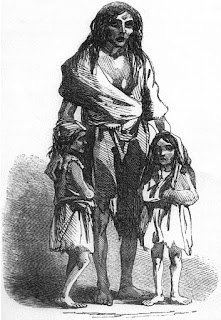
Stealing a Counterpane - 2 sisters who had a brother in the colony
39 Charges of stealing Money.
*36 Crimes were stealing clothing items.
 |
| Image Wikipedia ©© |
My research to determined a motive for Kitty Keeffe's attempted theft of salad oil from Mr Glenton's shop in Mary Street, Dublin in May 1826 has been interesting. Irish newspapers from the time of this crime have provided significant information about 19th century uses of salad oil, and thus clues as to why Kitty might have needed such an item. Catherine Keeffe's convict records have offered me details about her character and behavior after arrival in Sydney. By assembling information about the time and place in which Kitty Keeffe lived, I have better been able to understand her crime within the historical context of its occurence. I have reached the following conclusions about possible motives for Kitty's alleged crime.
The facts suggest that Kitty Keefe was guilty as charged.
The
Freemans Journal reported Kitty Keeffe as being
an old offender, and that was reason enough for the jury to determine her guilty. This suggests that her past criminal activity was known to the court ( I suspect it was not her age to which
old offender referred). It is entirely possible that Mr Glenton had been the victim of the felonious intentions of Kitty Keeffe prior to May of 1826.
It was unlikely that Kitty Keeffe committed this crime in order to be transported.
Since there is no record of her children having been convicted prior to her transportation either in the Irish to Australian Convict Transportation Database or in Kitty's own Australian Convict Records, (which frequently detail family members previously transported) I do not believe that she stole the salad oil in order to be sent to Australia.
It is unlikely that Kitty Keeffe was desirous of a dressing for a salad or that she needed salad oil for any other culinary purpose.
I think it improbably that the motive for Kitty Keeffe's crime was a culinary need. My research indicates that the theft was more likely prompted by medicinal needs, most practicably for relief of leg cramping or ear-ache. From her troublesome behavior in New South Wales, I also think it doubtful that flatulence would have concerned Kitty. Since salad was not a food typically in the diet of a servant in Ireland in 1826 and as a convict, being charged more than once with
drunkenness, it seems unlikely that Mrs Keeffe was concerned about a healthy diet.
Painful ear-ache was certainly a condition which could have affected Kitty Keeffe and working as a house servant in her middle years she might realistically have suffered leg cramps. Medicines for relief of these afflictions were priced far beyond Kitty's reach and a curing bottle of oil on a shelf in Mr Glenton's shop could certainly have been a temptation. Relief from painful medical symptoms would be a reasonable and comprehensive explanation for the theft of olive oil in 1826, particularly as its remedial effectiveness was much advertised in Irish newspapers throughout the 1820's.
 |
| Artist: Jean-Baptiste Greuze Image Wikipedia ©© |
Monetary gain as a motive for theft cannot be ruled out.
Olive oil was an expensive, imported item, which in 19th century Ireland was a product that only wealthy citizens could afford. One practical theory that might explain Kitty's theft is a possible market for the on sale of expensive olive. If one pictures the layers of a wealthy 1820's Dublin household as being much like the English
Downton Abbey in the popular television series, (since many of the wealthy in Ireland were English), it is not impossible to imagine the sale of ill-gotten produce for the household kitchen being used as a way to earn illicit money within the servant quarters. I have found no evidence to suggest this motive in newspapers, although the smuggling of costly imported foods to Ireland was widely reported.
 |
| Author: Jorge Royan ©© |
My journey with Kitty Keeffe, salad oil thief had been a fascinating one. From a cursory glance at a news item where the 19th century use of the words
salad dressing intrigued me, through an exploration of salad through the ages, to a plausible reason for the unusual theft of olive oil, I have been enthralled by Kitty Keeffe's story. If any of her descendants find this blog and have more information to tender I will be only too happy to enrich her tale further.
As a small afterthought, I cannot help but wonder if Kitty's story might have been even more colourful had she waited two years for the discovery of a
very fine and inviting new oil distilled from maize....
 |
| Freemans Journal 28 July 1829 [29] |
Footnotes
1. "The Food Timeline",
http://www.foodtimeline.org/foodsalads.html/ accessed 16 August 2017.
2. Solomen H. Katz,
Encyclopedia of Food and Culture, Charles Schribner's Sons, New York, 2003. 224-5.
3. Platina,
On Right Pleasure and Good Health, [Italain:1475, original text in Latin, translated by
Mary Ellen Milham, Medieval & renaissance Texts & Studies, Tempe, 1998, p. 213, Food
Timeline,
http://www.foodtimeline.org/foodsalads.html/ accessed 17 August 2017.
4. Apicius, Book 1 Recipe 35, http://hilobrow.com/2012/07/22/de-condimentis-14-dress-my-salad/
accessed 20 August 2017.
5. Restauranting Through History,
Basic Fare, https://restaurant-
ingthroughhistory.com/2011/06/06/basic-fare-salad/ accessed 22 August 2017.
6. "Recorder's Court",
Freemans Journal, 27 May 1826, p .2., Irish Newspaper Archives,
https://www.irishnewspaperarchive.com
/ accessed 20 August 2017
7. New South Wales, Australia, Certificates of Freedom, 1810-1814, 1827-1867 [database on-line]. Ancestry.com, Provo, UT, USA: Ancestry.com Operations, Inc., 2009.Original data: New South Wales Government. Butts of Certificates of Freedom. NRS 1165, 1166, 1167, 12208, 12210, reels 601, 602, 604, 982-1027. State Records Authority of New South Wales, Kingswood, New South Wales.
8.
State Archives NSW; Series: NRS 12188; Item: [4/4012]; Microfiche: 663
Ancestry.com. New South Wales, Australia, Convict Indents, 1788-1842 [database on-line]. Provo, UT, USA: Ancestry.com Operations, Inc., 2011.
9. State Archives NSW;
Roll: 851, Ancestry.com. New
South Wales, Australia, Gaol Description and Entrance Books, 1818-1930 [database
on-line]. Provo, UT, USA: Ancestry.com Operations, Inc., 2012.
10. State Archives NSW;
Roll: 851, Ancestry.com. New
South Wales, Australia, Gaol Description and Entrance Books, 1818-1930 [database
on-line]. Provo, UT, USA: Ancestry.com Operations, Inc., 2012.
11.
State Archives NSW;
Roll: 175, Ancestry.com. New
South Wales, Australia, Gaol Description and Entrance Books, 1818-1930 [database
on-line]. Provo, UT, USA: Ancestry.com Operations, Inc., 2012.
12.
New South Wales, Australia, Certificates of Freedom, 1810-1814, 1827-1867 [database on-line]. Ancestry.com, Provo, UT, USA: Ancestry.com Operations, Inc., 2009.Original data: New South Wales Government. Butts of Certificates of Freedom. NRS 1165, 1166, 1167, 12208, 12210, reels 601, 602, 604, 982-1027. State Records Authority of New South Wales, Kingswood, New South Wales.
13. "John Reagan",
Dublin's Evening Packet and Correspondent, 19 March 1829, p. 1.,
Irish Newspaper Archives, https://www.irishnewspaperarchive.com/ accessed 8 August 2017.
14. "Monthly Commercial Report",
Freemans Journal, 7 September 1818, p. 6., Irish Newspaper
Archives, https://www.irishnewspaperarchive.com/ accessed 6 August 2017.
15. "New Zante Currants and Olive Oil",
Freemans Journal, 14 November 1825, p. 1., Irish
Newspaper Archives, https://www.irishnewspaperarchive.com/ accessed 8 August 2017.
16. "French Goods",
Freemans Journal, 11 December 1824, p. 1., Irish Newspaper Archives,
https://www.irishnewspaperarchive.com/ accessed 3 August 2017.
17. "New Sicily Barilla",
Belfast Newsletter, 30 Cecember 1828, p. 2., Irish Newspaper
Archives, https://www.irishnewspaperarchive.com/ accessed 3 August 2017.
18.
Mrs Beeton's Book of Household Management, (originally published as twenty-four newspaper columns from 1859 to 1861), Isabella Beeton, Sarah A. Chrisman (Forward by)Abrudged Version, United States, 2015.
19. Belfast Newsletter, 27 May 1823, p. 2., Irish Newspaper Archives,
https://www.irishnewspaperarchive.com/ accessed 7 August 2017.
20. "The Gout", Freemans Journal, 9 November 1821, Irish Newspaper Archives,
https://www.irishnewspaperarchive.com/ accessed 14 August 2017.
21. Salisbury and Winchester Journal, 25 December 1826, p. 4., British Newspaper
Archives, http://www.britishnewspaperarchive.co.uk/ accessed 14 August 2017.
22. "Purified Windsor Soap",
Freemans Journal, 7 February 1824, p. 1. Irish Newspaper
Archives, https://www.irishnewspaperarchive.com/ accessed 8 August 2017.
23. "Transparent Soap",
Freemans Journal, 12 July 1827, p. 1., Irish Newspaper Archives,
https://www.irishnewspaperarchive.com/ accessed 12 August 2017.
24. "The New Light",
Freemans Journal, 7 February 1827, p. 4., Irish Newspaper Archives,
https://www.irishnewspaperarchive.com/ accessed 12 August 2017.
25. "A Luminous Bottle",
Freemans Journal, 25 August 1827, p. 1., Irish Newspaper
Archives, https://www.irishnewspaperarchive.com/ accessed 8 August 2017.
26. Taunton Courier and Western Adviser, 30 July 1823, p. 8., The British Newspaper
Archive, http://www.britishnewspaperarchive.co.uk/ accessed 10 August 2017.
27. Mairtin Mac Con Iamaire,
The History of Eggs in Irish Cuisine and Culture, Dublin Institute
of Technology, Dublin, 2007.
28. "Dandelion",
Freemans Journal, 22 December 1824, p. 4., Irish Newspaper Archives,
https://www.irishnewspaperarchive.com/ accessed 8 August 2017.
29. "Dandelion",
Freemans Journal, 22 December 1824, p. 4., Irish Newspaper Archives,
https://www.irishnewspaperarchive.com/ accessed 14 August 2017.
30. "Dandelion Folklore and Magic", ht
tps://www.thoughtco.com/dandelion-magic-and-folklore-
31."A Dark grey Horse",
Belfast Newsletter, 9 October 1807, p. 3., Irish Newspaper Archives,
https://www.irishnewspaperarchive.com/ accessed 21 August 2017.
32. "A New Oil",
Freemans Journal, 28 July 1829, p. 4., Irish Newspaper Archives,
https://www.irishnewspaperarchive.com/ accessed 8 August 2017.
Sources
Apicius, Book 1 Recipe 35, http://hilobrow.com/2012/07/22/de-condimentis-14-dress-my-salad/
accessed 20 August 2017.
Ancestry.com.au
Findmypast.com.au
"Dandelion Folklore and Magic", ht
tps://www.thoughtco.com/dandelion-magic-and-folklore-
Irish Newspaper Archives
Katz, Solomen. H.,
Encyclopedia of Food and Culture, Charles Schribner's Sons, New York, 2003. 224-5
Mac Con Iamaire, Mairtin,
The History of Eggs in Irish Cuisine and Culture, Dublin Institute
of Technology, Dublin, 2007.
Platina,
On Right Pleasure and Good Health, [Italain:1475, original text in Latin, translated by
Mary Ellen Milham, Medieval & renaissance Texts & Studies, Tempe, 1998, p. 213, Food
Timeline,
http://www.foodtimeline.org/foodsalads.html/ accessed 17 August 2017.
Restauranting Through History,
Basic Fare, https://restaurant-
ingthroughhistory.com/2011/06/06/basic-fare-salad/ accessed 22 August 2017.
The British Newspaper Archive
The Food Timeline", http://www.foodtimeline.org/foodsalads.html/ accessed 16 August 2017


